Governed AI · Software maintenance
Forge: from request to verified change
Live software never stops asking for work. Bugs, feedback and enhancements arrive from every direction, and the hard part is no longer writing the code.
A coding agent is not a process
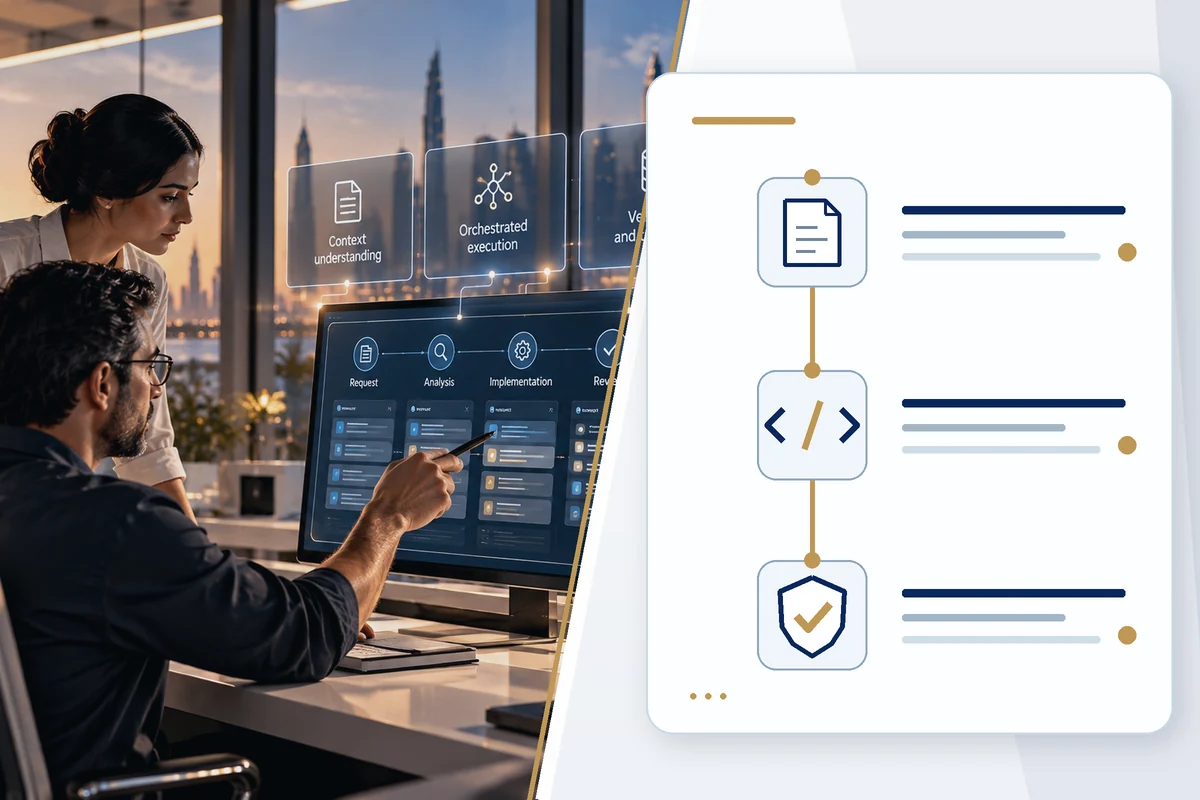
AI coding agents have changed what a single developer can produce in a day. But an agent does not organise incoming requests, decide what matters most, verify that a change does what was asked or answer for a release. When agents are dropped into a team without a process around them, coordination becomes the real cost: more changes to review, more context to rebuild, more risk of something slipping through.
The bottleneck has moved
Writing code is no longer the constraint. The value now lies in the governed process around the agent: understanding the request, planning the change, checking the result and keeping a record that the team can trust. That is the gap Forge is designed to fill.
What Forge is
Forge is the YasIQ engine that turns requests into verified change. Applied to software maintenance, it sits between the requests, the codebase, the AI agents and the people responsible for the product, and connects them in one governed flow.
Who does what
- Agents analyse requests, read the codebase, write code and tests, and review changes.
- Specialists prioritise, verify, approve and remain accountable for what is released.
A governed pipeline in six steps
Every request travels through the same path. At each step the system produces something concrete, and a person keeps control of what matters:
- Input and triage: requests are collected, classified and de-duplicated.
- Opportunity brief: the request is turned into a clear statement of the problem, its impact and its context.
- Sense-check and plan: the proposed approach is checked against the codebase and planned before any code is written.
- Execution and review: agents implement and test the change, and the result is reviewed.
- Merge and close: the change is merged only with the required authorisation, and the request is closed with its evidence.
- Learning and steering: validated outcomes improve how agents handle similar work next time.
Configurable autonomy
Teams choose how much freedom agents have, per type of task:
- Advisory: agents analyse and propose; people do the rest.
- Assisted: agents prepare complete changes for human review and approval.
- Auto: limited to eligible, well-defined tasks, with stop conditions and explicit authorisation before merge.
Whatever the level, the work is always traced: briefs, plans, diffs, tests, overrides and approvals are kept together, so any change can be reconstructed and explained.
Project Knowledge that grows
Forge draws on the history of the project: its Git history, the cases a specialist has validated and the steering given to agents over time. Each verified change makes the next one better informed, so the system becomes more useful the longer it works on a codebase.
Sovereignty by default
Source code is among an organisation’s most sensitive assets. By default Forge runs on the client’s own servers, the code stays inside its perimeter, and local inference is available in dedicated set-ups when external models are not acceptable.
Governed by people. Powered by Forge.
 Watch on YouTube · 2-minute explainerForge: From Request to Verified Change | Governed AI for Software MaintenanceYasIQ channel · opens in a new tab
Key takeaways
- In software maintenance, writing code is no longer the bottleneck. Coordination and verification are.
- Forge connects requests, codebase, agents and people in one six-step governed pipeline.
- Autonomy is configurable from Advisory to Auto, and every change is traced.
- Code stays within the organisation’s perimeter by default.
Frequently asked questions
Is Forge an AI coding assistant?
No. Forge is the engine that governs the process around coding agents: triage, briefs, planning, review, authorised merge and learning, with a complete trace of each change.
Can Forge merge changes automatically?
Only in Auto mode, only for eligible and well-defined tasks, and only with stop conditions and explicit authorisation to merge.
Does our source code leave our infrastructure?
By default Forge runs on the client’s servers and the code stays within its perimeter. Local inference is available in dedicated set-ups.
Want to explore how this applies to your organisation?
Discuss your challenge