Governed AI · Ways of working
People and AI agents as one governed workforce
Organisations are investing heavily in AI, yet few can point to a measurable return. The reason is rarely the intelligence of the model. It is the way AI is put to work.

Why enterprise AI stalls
The numbers are hard to ignore. MIT NANDA’s report The GenAI Divide: State of AI in Business 2025 found that around 95% of organisations see no measurable return from their generative AI initiatives. In the same year, Gartner predicted that more than 40% of agentic AI projects will be cancelled by the end of 2027, citing rising costs, unclear business value and inadequate risk controls.
At the same time, AI is everywhere inside companies. The MIT NANDA research describes a widespread “shadow” use of personal AI tools by employees, far beyond the official subscriptions their employers have purchased. People clearly find AI useful. Organisations struggle to turn that usefulness into reliable work.
The problem is the fabric, not the model
When AI fails in a company, it usually fails in the same way. It works without the sources the organisation trusts, without the decisions that give work its direction, and without accountable owners who answer for the result. A brilliant answer that nobody can trace, approve or own is not a business outcome.
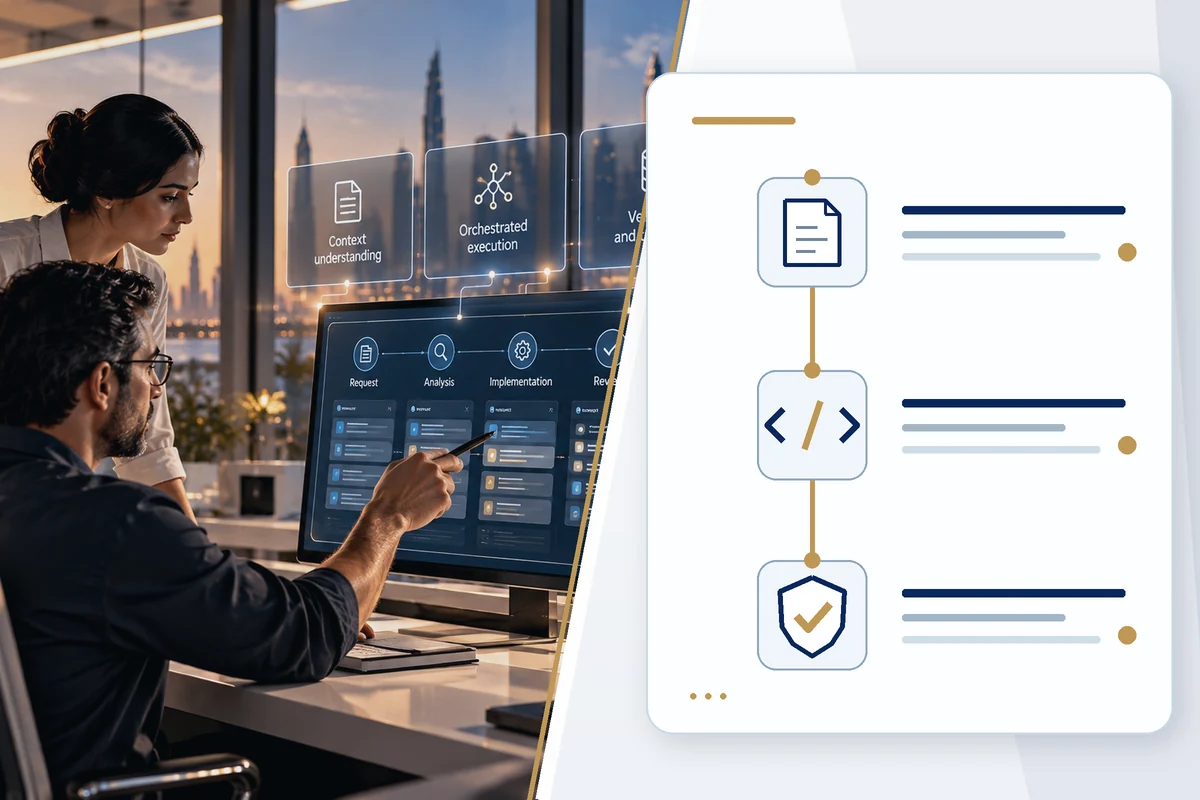
The missing piece is an operating fabric: the company’s sources, rules, decisions and accountability brought together in one place, so that every piece of work, whether done by a person or an agent, happens inside it.
One workforce, two kinds of members
YasIQ approaches this by treating people and AI agents as a single governed workforce, with a clear division of labour:
- Agents read, compare and build. They gather sources, check documents against each other, prepare analyses, drafts and options.
- People decide, sign off and are accountable. They set the objective, judge the options, approve critical steps and answer for the outcome.
This is not a hand-off at the end of the process. Human judgement sits inside the flow of work, at the points where it matters.
The same rules for agents and people
A governed workforce only works if everyone follows the same rules. In practice that means five things apply equally to agents and to people:
- Identity and role: every actor is known, and its role defines what it can do.
- Access: each actor sees only the information its task requires.
- Sources: work is grounded in authorised, identifiable Knowledge.
- Gates: critical steps pass defined checkpoints before they move on.
- A full trace: what was examined, what was decided and who authorised it is recorded.
Levels of autonomy, set by the organisation
Not every task deserves the same freedom. Autonomy is configured per type of work: from agents that only advise, to agents that prepare work for approval, to agents that complete low-risk, well-defined tasks on their own. Some things remain outside an agent’s remit at every level. An agent does not approve its own work, does not change the rules it operates under, does not act beyond its permissions and does not sign on behalf of a person.
Example: from an idea to a decision
Imagine a team proposes using an AI model hosted outside the country for a new internal service. In a governed workforce, agents collect the relevant policies, the data flows involved and the contractual terms, compare alternatives, and prepare a short decision brief with references. The brief reaches the person with authority over data protection, who decides, with conditions if needed. The decision, its evidence and its owner are recorded, and the next steps follow from it. Nothing is lost in email threads, and the reasoning can be reconstructed months later.
Ten of the right people
The aim is not to replace people. It is to let a small number of the right people, supported by well-governed agents, do faster and better the work that would otherwise require many more. Agents absorb the reading, comparing and preparing. People spend their time on judgement, relationships and responsibility.
A sovereign company fabric
Because this fabric holds an organisation’s Knowledge and decisions, it must stay under the organisation’s control. Data remains within authorised boundaries, models can run locally where needed, and external AI services are used deliberately, with only the context they are permitted to see.
 Watch on YouTube · 2-minute explainerPeople + AI Agents as One Governed Workforce | The Hybrid Operating SystemYasIQ channel · opens in a new tab
Key takeaways
- AI rarely fails for lack of intelligence. It fails when it works without sources, decisions and accountable owners.
- A governed workforce gives agents the reading, comparing and building, and gives people the decisions and the sign-off.
- Identity, access, sources, gates and a full trace apply to agents and people alike.
- Autonomy is configured per task, and some actions never belong to an agent.
Frequently asked questions
What is a governed hybrid workforce?
It is an operating model in which people and AI agents work inside the same rules: known identities and roles, controlled access, authorised sources, defined approval gates and a complete trace of what was done and decided.
Do AI agents make decisions on their own?
Only where the organisation has explicitly allowed it, for low-risk and well-defined tasks. Critical decisions, approvals and signatures remain with authorised people.
Why does enterprise AI so often fail to deliver a return?
Industry research points to integration and governance gaps rather than model quality. AI that is disconnected from trusted sources, decisions and owners produces answers, not accountable work.
Want to explore how this applies to your organisation?
Discuss your challenge